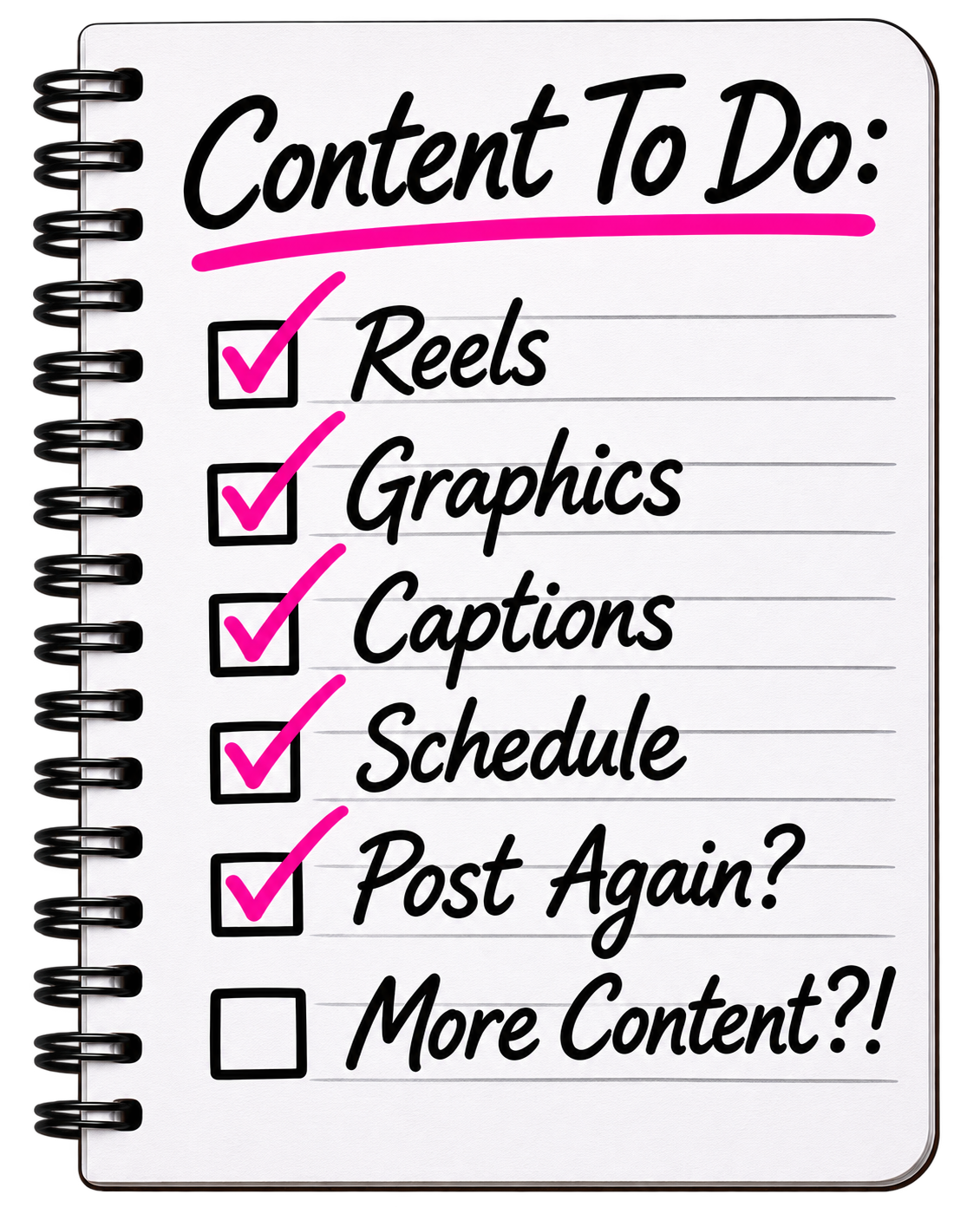
Why posting consistently isn't the same as building a content strategy. Everybody wants to post more. More reels. More graphics. More content. But what happens when you're posting consistently and nobody remembers your brand? Somewhere along the way, content creation became a numbers game. And in the rush to keep up, some brands forgot to ask a more important question:
What are we actually trying to say?
We've been told that consistency is everything. Post every day. Stay visible. Keep feeding the algorithm. While consistency matters, I think we've gotten a little too comfortable confusing activity with progress. Because posting something just to have something up doesn't necessarily move your brand forward. Sometimes, it just adds to the noise.
When content becomes a checklist
I recently experienced this firsthand while working on social media strategy and content development for a nonprofit focused on art and healing. Like many organizations, the goal was to maintain an active online presence while working with limited time and resources. AI-generated content had been part of the approach, and I understand why.
AI can help generate ideas, produce captions, and create graphics in a fraction of the time it would take to develop everything manually. But there's something I've noticed about relying too heavily on generated content.
You can have a perfectly acceptable post that doesn't really say anything.
The message might be positive. The design might look nice. The caption might sound encouraging. But does it connect with the audience? Does it reflect the organization's identity? Does it give people a reason to respond? More importantly, does it lead anywhere?
Those were the questions I started asking.
The difference a curated post can make
Instead of approaching every post as a separate assignment, I wanted to look at the bigger picture.
What conversations were we trying to start?
What did our audience care about?
How could one piece of content introduce an idea that we could continue exploring?
When we put more thought into the creative direction, messaging, and presentation of a post, we began seeing a different response. A carefully curated piece gained more traction than the content we had been relying on. But what interested me most wasn't just the engagement.
It was what that post made possible next.
We now had a topic people were responding to and rather than moving on to something completely unrelated, we could build from that response. A follow-up post could explore another side of the conversation. A reel could bring the topic to life. A question could invite the audience to share their experiences. Each piece could stand on its own while contributing to something bigger. That's where content starts becoming a story instead of a collection of unrelated posts.
And that's where strategy comes in.
One post shouldn't have to do all the work
Think about how many brands publish content that has absolutely nothing to do with what they posted the day before.
Monday is an inspirational quote.
Tuesday is a promotional graphic.
Wednesday is a trending reel.
Thursday is something generated because nobody knew what else to post.
Individually, those posts might be fine. But what are they building together? I'm not suggesting every post needs to be part of a series. Sometimes a standalone piece is exactly what's needed. But there should be some intention behind what you're publishing.
Take a topic like writing as a form of healing. One post might introduce the connection between writing and emotional expression. Another could explore a personal reflection. A third could invite the audience to try a writing exercise and share their experience. Now you're not just posting about healing. You're creating opportunities for people to participate in the conversation. And when people connect with a topic, you've learned something valuable about what interests them. That can inform what you create next.
It doesn't guarantee the next post will perform well. But it gives you a much stronger starting point than guessing.
So where does AI fit into this?
I don't think AI is the enemy of creativity. I think the problem begins when we start expecting it to replace creative judgment. AI can help you brainstorm. It can organize your thoughts. It can make parts of the production process more efficient. But it doesn't automatically understand your audience, your organization's history, or the conversations you've already had with your community. That understanding has to come from somewhere.
A generated caption might be grammatically perfect and still miss the point.
A beautiful graphic might attract attention without giving anyone a reason to care.
And a month's worth of scheduled content might look productive without actually building anything meaningful.
That's why I believe creative direction matters just as much as content production. Someone still needs to decide what deserves to be said, how it should be presented, and where the conversation should go next.
The goal isn't just to be seen
Working on this project reinforced something I've come to believe about marketing:
The goal shouldn't be to publish as much as possible. It should be to make what you publish matter.
Sometimes that means spending more time developing one strong idea. Sometimes it means listening to the audience before deciding what to create. And sometimes it means taking a post that worked and asking, "How do we build on this?" Because engagement isn't just a number on a report. It's feedback.
And if you're paying attention, that feedback can help shape the next chapter of your brand's story. So before adding another ten posts to your content calendar, maybe ask yourself:
Are we creating content because we have something to say, or because we feel like we have to post?
There's a difference.
And your audience can often feel it.
New Lit City Creative Agency | Marketing, Content Creation & Creative Direction