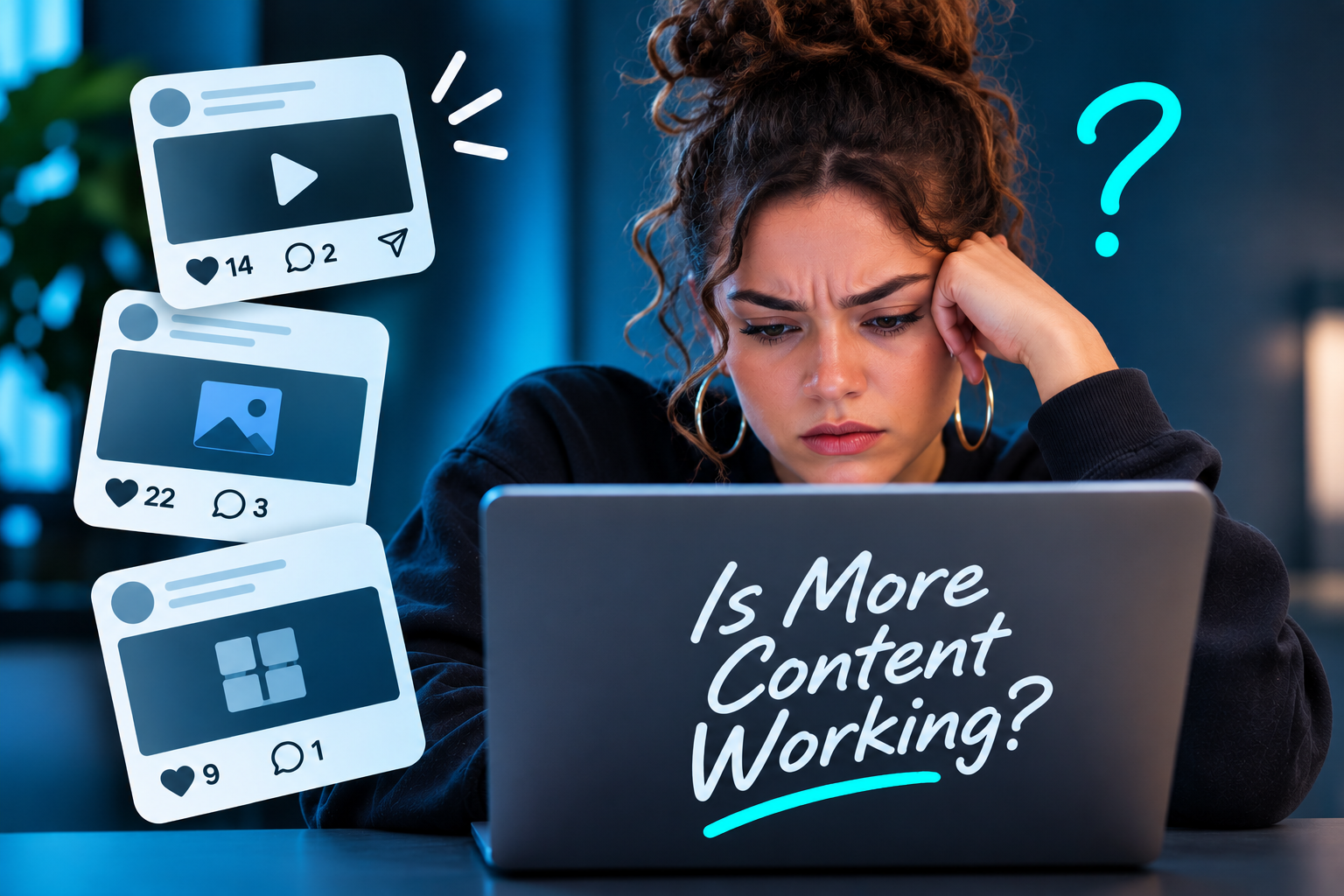
You have 200 followers, a full content calendar, and a posting schedule that never seems to stop. But is all that activity actually helping your business grow?
Everywhere you look, someone is telling you to post more. Post daily. Post multiple times a day. Stay consistent. Keep feeding the algorithm. For small businesses and growing creators, that advice can quickly turn social media into a never-ending production schedule.
You finish editing one reel, publish it, check the numbers, and immediately start working on the next one. Before you've had a chance to understand how your audience responded, you're already thinking about tomorrow's content.
But here's something worth questioning: Are you posting at a pace that makes sense for the audience you actually have?
Does Your Content Need More Time?
There's a common assumption that if a social media post doesn't perform well within the first few hours, it's time to move on. The likes aren't coming in, the views seem low, and suddenly the next post feels like another opportunity to get things right.
However, content doesn't always reach its full audience immediately. Depending on the platform and content format, a post can continue gaining views, shares, and engagement days or even weeks after publication. A reel that starts slowly might eventually reach people who have never visited your profile.
Does that mean publishing something new will stop your previous post from circulating? Not necessarily. Platforms like Instagram and TikTok can continue recommending older content even after you've posted something new.
The bigger issue is how quickly businesses move from one post to another without examining the results.
If you're constantly creating, editing, and publishing, when are you taking the time to understand what people are actually responding to?
Let's Talk About Those 200 Followers
Imagine two small businesses, each with 200 Instagram followers.
Business A posts three times a day. That's 21 posts every week. There are product photos, reels, promotional graphics, and trending content. The account is active, but the owner spends most of their time preparing the next post.
Business B posts three times a week. Between posts, the owner responds to comments, shares content to Stories, interacts with potential customers, and studies which posts attract attention beyond their existing followers.
Which business is doing better?
You might assume Business B has the stronger approach, but we can't determine that without looking at the results. Business A could be reaching thousands of new people, while Business B might be struggling to expand beyond its existing audience.
That's the point. Posting frequency alone doesn't tell you whether a strategy is working.
A smaller follower count doesn't automatically mean you should post less. It means you should pay attention to whether your schedule is producing meaningful results and whether you can maintain the quality of your content.
Are You Competing With Your Own Content?
Think about how people actually use social media. Your followers aren't sitting around waiting for your next post. They're watching videos, responding to friends, following other businesses, and scrolling through an enormous amount of content.
If you publish several posts close together, some followers may see only one of them. Others might see none. Multiple posts can divide your audience's limited attention, although that doesn't mean the algorithm automatically penalizes you for posting frequently.
For a business with a smaller audience, that distinction matters.
Let's say you publish a detailed carousel explaining a service your business offers. Two hours later, you post a promotional graphic. Later that evening, you upload a reel.
Each post might have value, but are you giving people a clear opportunity to engage with the information? Are you promoting the content through Stories, answering questions, or directing interested viewers toward your website?
Or are you simply moving on because your schedule says it's time?
Sometimes the most useful thing you can do after publishing isn't to create another post. It's to support the content you've already shared.
Your Analytics Should Influence Your Posting Schedule
Instead of relying on someone else's formula, start paying attention to your own performance.
Reach tells you how many unique accounts are seeing your content. Shares and saves can help reveal which posts people find useful or worth passing along. Comments can show what starts conversations, while profile visits, website clicks, and inquiries can help you understand whether your content is encouraging people to take action.
And don't just look at the numbers immediately after posting. Compare how your content performs after 24 hours, several days, and a week when the platform provides that information.
You might discover that certain reels continue gaining views long after publication, while some promotional graphics receive most of their attention on the first day.
You may also notice that your audience responds better to a few thoughtful posts than to a constant stream of updates. Or you might discover that posting more frequently gives your business significantly greater exposure.
The goal is to identify patterns, not force your account into a posting schedule that works for somebody else.
Try This Before Increasing Your Posting Frequency
If you're unsure how often to post, experiment.
Start with a manageable schedule, such as three posts per week for four weeks. Choose content that supports your goals and pay attention to the results.
Then test a different schedule, perhaps five posts per week, while keeping your content quality, formats, and promotional efforts as consistent as possible.
Compare your total reach, average reach per post, engagement, profile visits, and any business results that matter to you. Consider how much time each schedule requires, too.
This isn't a perfect experiment. Different topics, trends, and audience behavior can influence performance. But it's more useful than assuming daily posting is the only path to growth.
And remember, the right posting frequency can change as your business grows.
Consistency Doesn't Have to Mean Constantly
There's a difference between being consistent and being constantly visible.
Consistency means showing up reliably, maintaining your brand's voice, and creating content that serves a purpose. It doesn't necessarily mean posting every day.
We explored a related idea in our first article, “Your Brand Doesn't Need More Content. It Needs a Point of View,”where we discussed why a full content calendar isn't the same as an intentional marketing strategy.
Posting frequency adds another layer to that conversation.
You can have a recognizable brand, strong creative direction, and a well-developed content strategy while posting three times a week. You can also have those things while posting daily. The question is whether your schedule supports your goals and your capacity to deliver quality work.
For smaller businesses, time is a resource. Every hour spent creating another graphic is an hour that could potentially be spent engaging with customers, developing a campaign, improving a service, or analyzing performance.
That doesn't make content creation less important. It makes understanding its value even more important.
Before You Hit Publish Again...
Ask yourself what your last few posts accomplished. Did they reach new people? Start conversations? Encourage someone to explore your business? Did you learn anything from the response?
If the answer is unclear, it might be worth reviewing your strategy before adding more content to the calendar.
There isn't one perfect posting frequency for every account. Some businesses thrive on daily content, while others get stronger results with fewer, more intentional posts.
The goal isn't to post less just for the sake of posting less. It's to stop treating more content as the automatic solution to every marketing problem.
Coming Next: AI Is Changing Marketing. Are You Keeping Up?
Now imagine taking that pressure to post constantly and adding artificial intelligence to the equation.
What happens when a business can generate thirty captions in minutes, develop campaign concepts almost instantly, and create visuals without starting from scratch?
AI is changing how quickly businesses can produce marketing content. For small businesses and creative professionals, that creates opportunities that weren't always available.
But it also raises a new question: If technology makes it easier to create more content, does that mean we're creating better marketing?
In our next article, “AI Is Changing Marketing. Are You Keeping Up?”, we'll explore how artificial intelligence is reshaping the industry, why so much marketing is starting to look alike, and what businesses need to understand before relying on AI to drive their creative decisions.
Check back for our next article. We're moving from how often you should post to how the tools behind your content are changing.
Ready to put these ideas to work for your brand? Let’s talk
New Lit City Creative Agency | Social Media Strategy, Marketing & Creative Direction